Showing posts with label Bryan Heal. Show all posts

Thursday, 9 April 2015

Create a moment worth sharing

I recently started to use the professional blog ... posting ... "Pulse" platform on LinkedIN to test out how usable it is, relevant to that network, and its various tools for amplification and measurement of its relative readership/reach.  Ultimately, to evaluate whether it is in fact the right place to launch that particular type of content.

Recognizing I am in the early stages of this journey, but I was certainly happy with how the first few days have gone since the initial post this past week.  Lots to learn and more to do, but it is already starting to show its value with regards to balancing ease of use from a writing perspective to (relative) easy of reach and building connections with broader individuals and networks outside of my immediate own.

What that preamble out of the way, my LinkedIN Post, titled: Create A Moment Worth Sharing


Sunday, 14 July 2013

Harlem

Chant another song of Harlem.

Not about the wrong of Harlem.

But the worthy throng of Harlem. 

Proud that they belong to Harlem.

They, the overblamed in Harlem.

Need not be ashamed of Harlem.

All is not ill-famed in Harlem.

The devil, too, is tamed, in Harlem. 

                                           - Anonymous, circa 1925

Friday, 10 May 2013

Dorset Park Hub Helps Community Grow

I am proud to be quoted in this story on TO's newest community hub alongside Abeer Ali & Suganthine Sivakumar - two Scarborough women whose work ethic and committment to neighbourhood building is inspiring.

Link to article and full text below ...


The Dorset Park Community Hub is like a tree, and donations to the United Way are “like a seed planted in our community soil” that made it grow, area resident Abeer Ali said at a celebration this week.

“It’s a new life for us,” she said of the converted Kennedy Road plaza building that finally gives tenants from nearby apartment highrises a place to meet and, as Ali put it, to create their own memories.

Bryan Heal said people in Dorset Park are thinking about their future too.

“Residents and community members have taken ownership of this initiative right down to its very bones,” said Heal, a member of the Dorset Park Neighbourhood Association.

“Far from taking a gift like this for granted we’re working our tails off.”

The sort of activities seen at 1911 Kennedy just north of Ellesmere Road weren’t possible when the hub was still a dream and the local headquarters of Action for Neighbourhood Change, “a small outpost above the Hopper Hut,” a restaurant across the street, served as a community incubator.    

Suganthine Sivakumar, a resident since 2000, said a lack of space in the ANC office - or anywhere else - was a constant problem for people who wanted to organize programs or learn about their adopted country.

Sivakumar tried anyway, forming an English Circle with two other local women. “Lots of ladies need their English to improve. That’s why they’re staying home,” she said.

After three years, Sivakumar was hired to coordinate the women-only program, which operates Monday and Tuesday mornings at the hub and Wednesday and Friday mornings at McGregor Recreation Centre.

The 10,000-square-foot hub building, which opened its doors in November is visible, safe and has been used by 15,000 people, she said. “We can see new faces in here every day.”

The place is home to sewing classes, a community kitchen, a food bank, and programs for children and seniors, plus offices for the DPNA and agency partners led by Agincourt Community Services Association and ranging from the John Howard Society of Toronto to the CNIB.

In a program room hung with ceiling streamers, United Way Toronto CEO Susan McIsaac recalled it’s been almost a decade since the charity’s Poverty By Postal Code report found many Toronto communities had fallen far behind in their access to important services.

United Way, it was decided, had to invest in the city’s inner suburbs and enable residents who lived there, but McIsaac said without hard work from those residents hubs like Dorset Park’s wouldn’t have come to life.

The neighbourhood, centred on a stretch of Kennedy Road known for discount commercial sales, is one the city more or less created from Highway 401 to a few blocks south of Lawrence Avenue (the southernmost street it covers is Flora Drive), and from Birchmount Road to Midland Avenue.

Dorset Park - the real Dorset Park - is a local green space southwest of the Kennedy and Ellesmere intersection, and the area’s classification around 2005 as a “priority neighbourhood” has not been understood or welcomed by all.

But Aisha Farah, who served on the local youth council and is now part of a women’s cooking group for Canlish Road residents, said she considers Dorset Park home and “one of the most functional” of the 13 “priority” districts, a place, she said, that welcomes everybody.

“I’ve been showered by smiles from strangers, offered foods from very many ethnic flavours,” said Farah.

People at Tuesday’s official opening celebration also applauded Tami and George Cope, and Bill and Jan Hatanaka, part of a list of United Way donors which contributed $1 million between them.

Bill Hatanaka later said he grew up in Dorset Park “probably 50 yards from here.” He had been shocked, he said, to be shown a map of priority neighbourhoods, with the place where he enjoyed such a good upbringing included among them, but added “infrastructure often doesn’t keep up.”

The hub is a chance for people who are just like himself when he was young; it is a bridge to help establish themselves, Hatanaka said.

Tuesday, 30 April 2013

Jane's Walk 2013: A Dorest Park Discovery Walk


Tips for the Walk Day! (from our friends at Jane's Walk

  1. Wear sensible shoes – something cushy and supportive. But that doesn't mean you have to sacrifice fashion. After all, Nancy Sinatra recommends boots made for walking.
  2. Dress for the weather – all walks go rain or shine. It's easy to stay warm and dry if you layer up and bring an umbrella if it looks like rain. Plan your Jane's Walk itinerary ahead of time.
  3. Confirm the dates and times your tours are offered.
  4. Ask questions and offer insights. Jane's Walk works best when the tour has a friendly, conversational feel. Introduce yourself to fellow walkers, volunteers and guides. Be curious. 
  5. Consider attending walks in neighbourhoods you already know and even live or work in, to deepen your appreciation and networks in the area. 
  6. Cultivate your curiosity – venture farther afield and find out what is wonderful about neighbourhoods you've only heard about in the media or didn't even know existed. Be adventurous. 
  7. Take lots of pictures, savour the sites and sounds. Stop in at a cafĂ©, pub or restaurant and linger. Develop your own impression of an area and share it with others. 
  8. Get in close – in order to hear the tour guides stand close to the speakers. Remember to leave enough room on the sidewalk for people to pass by and make sure to cross at the corners. 
  9. Share your thoughts and feedback with us on our website, on Twitter and onFacebook and consider supporting this work with a tax-deductible charitable donation
  10. Thank the hosts and volunteers for giving their time to this thrilling insider's guide to your local community!

Saturday, 20 April 2013

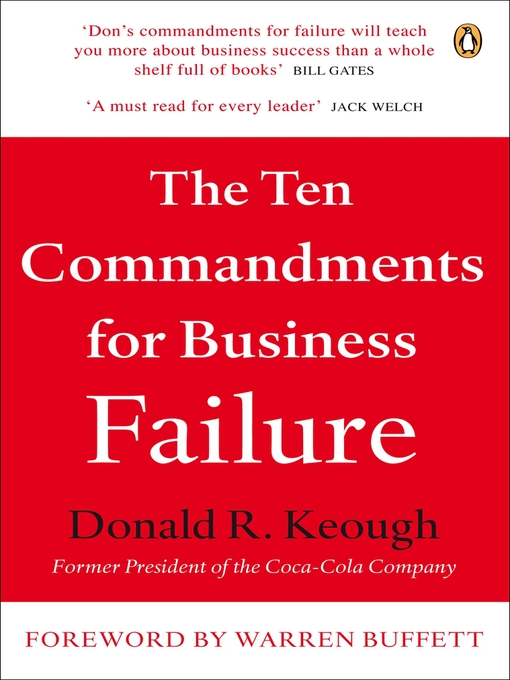
The Ten Commandments for Business FAILURE

This week I read Donald Keough's The Ten Commandments for Business Failure.  With easily digestible prose, clear examples, humility and humour - it's lessons are quickly understood and applicable well beyond the realm of business and for anyone interested in leading successful collaborations.  As former President of The Coca-Cola Company and one of the world's most sought after executive speakers, Keough, while quick to dispel any (or anyone's) claim of a legitimate silver bullet formula for success, is profoundly bullish on history's tried and true signs of failure.  Indeed, in example after example, and across sectors, cultures and historical contexts there lies ten blunders that companies and individuals make, and that when made over and over again they lead to failure so consistently that the list ought to be written in stone.  

Without further delay, the ten hallmarks of the pathway to failure are:  

01 - Quit taking risks
02 - Be inflexible
03 - Isolate yourself
04 - Assume Infallibility
05 - Play the game close to the foul line
06 - Don't take time to think
07 - Put all your faith in experts and outside consultants
08 - Love your bureaucracy
09 - Send mixed messages
10 - Be afraid of the future

Despite most being understood or quickly researchable from their names, I dare not elaborate more in this post and instead encourage you to pick-up a copy of the (short!) book or find one of his speeches online to consume, for Keough, like all great leaders, are masters of simplicity whose words are best spoken themselves.  

Wednesday, 17 April 2013

Of Tupaia and Captain Cook ...

Kudos to the team at National Geographic on their inspiring 125th Anniversary Special Issue.  Featuring an almost issue-length expose on Why We Explore, the maps, photos, stories and glimpses into the future of journeys through stars and space represent a tour de force of migratory history and possibility.  To my great pleasure it also recounted one of my favourite chance encounters following the storied human migration out of Africa.  

In the winter of 1769, the famed Polynesian priest Tupaia met and presented British Captain James Cook with a map - the first that any European had ever observed featuring each of the major island groups in the South Pacific spanning a massive oceanic distance from Fiji to the Marquesas.  What evolved was a friendship and now legendary journey on the ship Endeavour. From island to island and many islands more, Tupaia wowed the sailors by successfully navigating the ship regardless of weather, day or night time conditions, without any of the *fancy* tools and technology Cook and his team found essential.  Perhaps more than his crew, Cook understood the significance of Tupaia's talents, and hypothesized that islanders scattered throughout the Pacific were likely part of the same people who long ago had explored, settled and mapped this part of the Ocean long before Britain was ever, well, Britain.  

It would take another two hundred years before DNA evidence of modern human migration patterns would ratify Cook's hypothesis.  Indeed, Tupaia's ancestors had colonized the Pacific over 2,000 years prior following a long, incrementally eastward march out of Africa another 70,000-50,000 years before that.  Cook's journey, meanwhile, represented a comparable milestone in the opposite direction - that of the continued westward movement of his own ancestors who had left Africa in the opposite direction at about the same time.  Thus, the serendipitous meeting and travels of Cook and Tupaia represented a closing of the migratory circle and completing the journey their ancestors embarked on together so many millennia before. 


Wednesday, 10 April 2013

Between Two Worlds

It is helpful every once in a while to reflect on one's thoughts from a previous time and think about what has changed and what appears very much the same. Here is a re-posting of a blog entry I wrote in May 2007 that explored my work and travels on the margins of the ongoing climate debate. -Bryan


You can say that my life in recent years has been shaped by natural disasters. Working in the aftermath of earthquakes and Tsunamis had taken me on a memorable journey full of interesting places, people and conversation. It has helped shape career aspirations, given me wonderful friends, and has allowed me to develop a more global perspective on current events. Even though I spent much of ‘05-06 working specifically on issues related to the Indian Ocean Earthquake & Tsunami, it really is difficult to analyze that disaster as an isolated incident. The year that followed saw countless human tragedies of massive scale – from a string of hurricanes through Latin America & the Caribbean, to devastating earthquakes in Indonesia and Pakistan, to the United States and Katrina – perhaps the tipping point for many of us to finally force ourselves to step back and reflect on what the heck is actually occurring. Though our African brothers and sisters lacked such ‘sudden onset’ events to captivate the worlds attention, they were not free from disaster as crises’ in Sudan, Niger and elsewhere were further complicated by food insecurity caused by record drought from the drying up of their lakes and rivers.

Whether I was brainstorming with colleagues in Geneva, having drinks with friends, or shooting the sh&t with random faces in far away places – the conversation never failed to turn towards how unstable this world has become. It didn’t matter if we were doctors, lawyers, engineers, public health professionals, insurance agents, journalists, fisherman or farmers – the central role of the environment and the generally poor political acknowledgement of this among donor nations became a sobering reality for us all. Some have said that people have difficulty grasping the importance of things they cannot see; that it takes a truly profound event in their own lives before they are able to connect all the dots. While that maybe true of some places in regards to global warming – for us it wasn’t so – things were happening very quickly all around – all we had to do was look and listen.

For a country that I did not know existed three years ago, the Maldives now occupies a special place with me. As a long north-south archipelago of over 1000 small islands in the Indian Ocean, it is a breathtakingly beautiful country filled with genuinely nice and caring people. After visiting a subset of these islands, however, to simply say these islands are small is a huge understatement as many of them have a circumference that is easily walked in half an hour. With an average elevation of only 1.5m above sea level, they further claim the title of the lowest lying place on Earth. As you might imagine, the impact of rising oceanic water levels are as clear here as anywhere – and this is evident in government priority setting and planning as officials are constantly thinking of tomorrow, pondering land reclamation schemes and forming alliances with other small island chains to search for solutions. This is a nation literally fighting for their very existence because of climate change – and it is of no fault of their own. With minimal industrial emissions, automobiles and energy consumption – they can safely thank the rest of us for much of their current fate. Perhaps the first moral lesson I carry home is that when a country such as my own contributes to this global mess, we have a responsibility to help clean up that same global mess - and not just in our own backyard.

From one extreme face of global warming to another – I visit one of the most famous glaciers on Earth as the summer of 2006 brings three friends and I to Tanzania and the summit of Mt Kilimanjaro – Africa’s lone remaining snow capped peak. Whether you have been there yourself, have watched An Inconvenient Truth, or have been shown photographs from other travelers, scientists or activists – you might have heard that this glacier is melting away. And it is melting FAST – with current thinking that the snows of Kilimanjaro will be no more in as little as 15 years. On the ground these reports were all corroborated by mountain guides, porters, safari drivers and other local residents we spoke to who all claim that scientific measurements are not even necessary – that even by the naked human eye it is visibly shrinking which each passing year. But what we don’t hear amidst all of these reports is how agriculturally, economically and ecologically dependent the nearby towns, communities and wildlife reserves are on the existence of this glacier and the waters that flow from it in the summer months. Even though Tanzania has traditionally been geographically well positioned so as to not experience the extent of drought that plagues elsewhere on the continent – as their internal waterways gradually dry and Kilimanjaro melts away, the impact on a giant share of its human and world famous animal populations will be devastating.

Since our adventure in East Africa, I have returned home to Toronto (Canada) where I continue to work and study. When settling home again following a long period of instability and regular traveling, there is an inevitable shell shock – a reflection period of sorts where one absorbs on the experiences they’ve had before they go out and really talk or write about where they’ve been and what they’ve seen. For me, this period lasted a little longer than expected and it wasn’t until fairly recently that I really became interested in communicating my story and ideas in more detail. The trigger for me, especially in regards to the welfare of the planet, was a conversation I had with Nancy Karetak-Lindell, Canada’s Member of Parliament for Nunavut. She was visiting Toronto as part of a town hall on “Northern Sovereignty” hosted by my local MP Carolyn Bennett. But it wasn’t just sovereignty that was discussed – we spoke of everything. As I had never really debated anything with someone from our Northern Territories before, this was a huge eye opener for me – it was non stop learning in hearing her perspective on current events and on the realities of life in our largest riding (inclusive of one fifth of our nations landmass!). Of all the issues, however, I was most captivated by talks on geography, and hearing her explain just how rapidly their climate and natural surroundings have changed in the past 20 years and are continuing to change; of how their culture is so immersed with their physical landscape, how there lifestyle is tied to the seasons, and how their very way of life is being redefined by our melting Arctic. Among other things, I immediately thought back to some of the places I’ve been and began to realize that this is by no means an “away” phenomenon; that it is no longer a “future” event that might one day come to pass; that it is happening here and now in our very home, and for those who still aren’t believers – it is time.

It’s as if we are caught between two worlds here in Canada. On the one hand - with 90% of our population within a short drive of the US border, many of us will probably not be terribly inconvenienced by global warming in the short term. Heck – I don’t like the cold and definitely wasn’t suffering from our record warm January ’07. Farmers won’t complain about the longer growing season, and politicians and corporations are already salivating at the prospects of the opening up of the Northwest Passage. But while this is occurring many places are already having their fears realized and some heavily populated parts of the planet could well be in crises within our lifetimes. This bubble we are living in is shrinking fast, and once the novelty of these things wear off, the dots to connect will become clear. The weather will be more sporadic, the storms more intense, and our true north will melt away; additionally, humanitarian crises engulfing so much of the rest of the world may lead to a boom in immigration and asylum seeking to spacious countries (like ours) as has never occured before. To paraphrase some recent statements by Al Gore, Stephane Dion and Tony Blair: We no longer lack scientific clarity on the reality of global warming, and there are no shortages of practical steps we as humans can now take. We know exactly the types of things that we can do to help prevent the Armageddon scenarios that have been prophesied – but we are lacking political will, and for this tide to turn in a democracy, it must be demanded by the people. On this issue, we are no longer living in a time where our grandchildren will be able to makeup for our mistakes. We are living in a time of consequence.


Aerial photograph of two Maldivian islands, taken by Ron Gluckman


Looking back on the Ice Fields from Uhuru Peak, Mt Kilimanjaro, taken by me

Sunday, 24 March 2013

CollaborAction: How Technology Can Help Organizing

This past week's CollaborAction conference was the latest offering of Maytree Foundation's Building Blocks initiative and was an impressive opportunity to network and learn with organizers in Toronto and from across Canada.  With so many meetings and conferences veering toward the snoozing-inspired where you attend for the networks amidst disappointingly substance-free content - I am happy to report that this was not the case on Wednesday!  

Indeed, one of the most engaging and content-heavy parts of the day was the breakout session delivered by Chris Cowperthwaite & Adel Boulazreg on the potential for data and technology in organizing people, volunteers and campaigns of all sorts.  Relevant to business, politics, marketing and community organizing alike - through real life, easy to understand stories and examples with NationBuilder, MailChimp and other tools, they clearly outlined how enterprise grade data, analytics and organizing applications are available at grassroots pricing for those interested in launching or scaling up a campaign for just about anything.  

CLICK HERE for Chris & Adel's slide's from the session for your review.  In future posts I will look to eventually compare and contrast tools like NationBuilder versus Blue State Digital and other applications with similar functionalities for use as a data-driven grassroots organizing platform.  


Tuesday, 19 March 2013

Toronto's Best Magazine Service

Congrats to everybody who thought of their library card when reading this title!  For the grand annual price of $2 for a membership, it is astounding the range of topics and skills one can learn through the Toronto Public Library (TPL) system.

As a regular commuter between Scarborough, North York and downtown Toronto, I am one of the scores of people who routinely grapple with how best to optimize the mobile learning and productivity potential of the extended time spent traveling through our beloved subway corridors.  With so much time already devoted to writing about issues, working up applications and networking from my computer - I tend to prefer using my commute and 'in between' periods for reading physical pages and other tasks that do not involve staring at a digital screen.  

Which brings me to TPL.  Inspired to renew my previously dormant membership after attending an info session for a business development series later in the year, I stumbled across the magazine racks on my way out and decided to pick up an issue of Popular Science to go.  Fast forward to home that evening following the perfect bit sized commuter read and armed with the knowledge that you can return items to any branch - I immediately began thinking about the next day and that my schedule would take me within close proximity to the Agincourt, Don Mills, Wychwood and Pape branches.  That day would indeed have me take out a total of three magazines and return four, and in the process facilitate a markedly more enjoyable commute for the most minimal of added efforts.  While my rate of new issues read has since plateaued at about 1 every 2-3 days, I am thoroughly enjoying getting caught up on recent trends in data analytics, healthier living and how to mine an asteroid.  Ok so not all topics are immediately relevant to the day to day, but my brain is a little more active, my knowledge base is getting a little bit broader, and until we figure out a real way to address congestion and commute times in Toronto - my train reads are immeasurable more enjoyable.  

Walk in to any branch at any time of the day and you can see people young and old from all walks of life reading for leisure, doing their homework, participating in community group activities, applying for jobs and learning skills ranging from graphics design to english literacy, financial management and just about any other need where someone has offered their time to teach, facilitate or organize.  Far from the traditional perception of being a place to take out books, branches have modernized into full fledged community hubs central to the connectivity, learning and socioeconomic potential of their neighbourhoods.  In less than a month of reactivating my membership, the only thing I kick myself for is having taken so long to have recognized the value of this gem of a service right down the street!        

So what is your best $2 investment?


Tuesday, 12 March 2013

Photos from Space

If you are like me, you are one of the hundreds of thousands of Twitter followers addicted to the daily updates from Canadian Astronaut Chrid Hadfield, NASA Commander of Expedition 35 currently orbiting Earth from the International Space Station.  In addition to the extraordinary contributions to science and human knowledge his team is making with each passing experiment, his brilliant use of popular digital media tools have forever transformed the way astronauts connect with dreamers and us mere Earth bound mortals.  

Of all his posts, my favourites have consistently been the 'nightly finale' photos of what he is looking down upon before going to bed at night.  They are stunning.  Below are a few recent ones ... to follow him online check him out on Twitter at @Cmdr_Hadfield


Monday, 4 March 2013

How to Write the Perfect Tweet

"How To Write The Perfect Tweet" - by Gerry Moran in the MarketingThink Blog ...


With only 140 characters in play, it seems pretty simple to write the perfect tweet! How hard can it really be when all you need is a few words to get your point across to your followers? Unfortunately, that is what many marketers and their management think how it works.

Perfection is not so easy to accomplish where there is so little room to work with. With limited real estate, your less than perfect tweet mistakes are magnified by your lack of skills and mistakes. Consequences can range from hurting your personal brand to leaving opportunity on the table by under-reaching or under-engaging with your current and potential audience!

To write the perfect tweet you need to connect your business goal you wish with your social content delivery. For instance, you may want to increase your thought leadership or drive awareness of your business.

3 Goals For Your Perfect Tweet

You likely will land on three social media goals for your tweets
  • Amplify - You need to amplify your story with tweets. 
  • Engage - You need people to read the tweet, click on it or pass the message on to others.
  • Convert - You need to have helped people enough with your great content that you contact you to do something. For instance, they might want to hire you to be their social media marketing coach!
Does Your Perfect Tweet Pass The Twitter Filter?

When you finally sit down to write your perfect tweet you need to make sure it passes through three key filters. Ask yourself this question before you hit that send button!
  • Is it interesting and readable?
  • Is it interesting enough to click?
  • Is it compelling and build to be retweeted?
 How To Write The Perfect Tweet Blueprint

Pew reports that adult usage of Twitter had doubled from 2011 to 2012, so “getting it write” is key to you maximizing Twitter’s potential.


Sunday, 3 March 2013

The Impossible


I recently saw The Impossible on the big screen and was entranced for the entire 114 minutes of screen time.  It was beautifully shot, expertly directed, well acted, and if I had one sour taste in my mouth after leaving the theatre it was that not nearly enough respect seems to have been given to Tom Holland for his portrayal of the character Lukas.  Upon its release and throughout this past awards season, the acting buzz surrounding this film has been focused exclusively on Naomi Watts.  Not wanting to take anything away from her who was great in a role that clearly involved an extraordinary amount of physical demands, but for me the performance that stole the entire show was Holland’s.  This young actor gave a deft performance and transcended an on screen role into meeting the emotional and urgency realities of the moment this film was trying to capture.

This film more than any I’ve watched this past year brought back a range of memories and emotions from a prior life.  At impact time zero of the 2004 Boxing Day Tsunami in the Indian Ocean I had a day job in an office of the Ministry of Health and Long Term Care and was also working a few nights a week at a sports bar in downtown Toronto.  For what felt like an endless string of shifts at the bar I remember a sudden sluggishness in my work having crept in as I was utterly transfixed by the images on the television sets of a disaster whose impact, scale and eventual response made redundant our use of the word unprecedented.  I was overwhelmed with an immediate inspiration to get involved.  I didn’t know at the time whether that would entail getting on a plane, raising money from home or something else entirely – I just knew that I was going to find my way into some kind of helping operation. 

What I didn’t appreciate at the time was just how quickly that would occur.  Indeed within a couple of weeks I was in an e-mail exchange with Dr Manuel Carballo and his team in Geneva, Switzerland where I had the privilege of interning a couple years prior.  Dr Carballo is the Executive Director of the International Centre for Migration, Health and Development (formerly International Centre for Migration and Health – ICMH) and is a giant in the global health arena. Having run operations for the WHO in Bosnia during the Balkans crises, joining the civil rights movement in the United States, leading breastfeeding campaigns in the developing world against intense resistance from multinational formula producers, and teaming up with Dr Jonathan Mann and Daniel Tarantola in the now legendary former Global Programme on AIDS – his attention was now squarely focused on the health of vulnerable people displaced and affected by the Tsunami and the quality and efficiency of the international response mechanisms enacted to help them. 

At a moment of serendipity I began reaching out to him just as they were looking for another team member to help research these issues, evaluate what was happening on the ground and at headquarter and donor levels far away; and then write about real time status reports, lessons learned and how aid efforts can be better coordinated and improved upon going forward.  Within a few weeks I was packing my bags for a return to Geneva, and in less than a week upon arrival I was asked to look up the VISA requirements for Canadians traveling to the Maldives.  And so began two years of incredible professional experience, personal growth, and being touched by so many of the visceral images, herculean logistical challenges and random acts of kindness which The Impossible began to touch upon. 

For I imagine a host of reasons I haven’t yet found a way to adequately talk about some of these experiences since coming home in a way that is worthy of what they meant.  Perhaps it was too much happening in rapid fire succession, perhaps getting through it required more doing then thinking and reflecting, or perhaps there is another rationale all together.  All I know is that I am suddenly motivated to again write about this time and how some of its seminal moments continue to shape how I approach life and work back home in Toronto.  While I may do so in blogs and through other mediums, I am not necessarily writing for the purpose of putting  something out into the world as much as I am trying to still make sense out of events that were happening too fast to adequately do so at the time.  


Tuesday, 19 February 2013

Wednesday, 6 February 2013

A new year, a new blog

Hola World ...

This blog has been dormant for sometime and resurrecting it has been on my mind for a good while now.  Since there is no better time to start reaching a goal than right now, let this be the first of an ongoing and more frequent string of new thoughts, pictures, posts and favourite curated content from things before my eyes.

Oh, and I've launched the start of my new website at www.bryanheal.com ... with seemingly endless social networks, sites visited, profiles, resumes and media items in all sorts of places around the web - I felt it important to take more control over my web content and develop a more simple, centralized home for me, my interests, profesional and volunteer experiences.  Check it out from time to time for updates on new things I'm working towards and for a more consolidated place where my blogger posts, twitter feeds, LinkedIN, Facebook & Google+ updates can connect.

-Bryan

Thursday, 23 June 2011

Tip of the hat to 3 people from 3 parties

        Although it never received the hype of poverty reduction or other high profile parliamentary committees - the Select Committee on Mental Heath has probably been the most functional one of all during this government, no doubt in part due to members of all 3 elected parties working together. 

        With reasoned debate, a respected consultation process and evidence-guided recommendations - they seemed, at least from an outsider's perspective, to have worked as a committee should.  While the debate will carry on as to how exactly the initiative will roll out and what the specific priorities will be - yesterday's announcement of a new 3 year $257 million strategy to support children's mental health (story at  http://ow.ly/5oNSF ) is an important product of their work, will help thousands of children youth and families, and is a committment that has a decent chance of surviving an election due to the multi-partisan approach in which it was developed.

        Big congrats are in order to Liberal MPP Kevin Flynn, PC MPP Christine Elliot, NDP MPP France GĂ©linas, and all others who worked hard on this one!


Tuesday, 19 October 2010

Toronto Star endorses Bryan!

I am delighted to share the news that the Toronto Star has endorsed our campaign for City Council in Ward 40! In their words:

“Fresh thinking and original perspectives are essential given the financial challenges and broad public frustration left behind by the departing council. More city-builders are needed in office — energetic people capable of co-operation and inspiration.”
"Well-spoken Bryan Heal, a worker at a non-profit agency helping children and youth, deserves a chance to show what he can do."

http://www.thestar.com/opinion/editorials/article/877330--star-s-choices-more-fresh-faces-for-city-council


Saturday, 16 October 2010

Weekend advanced vote is here!

Hi Everyone!

If you haven't already done so, be sure to go out and vote this weekend! Polling locations are being set up in every ward, and Bryan will be joining Ward 40 residents at Holy Spirit Catholic Church to cast his ballot on Sunday.

This is the only weekend opportunity people will have to vote, so we will be pushing hard encouraging as many people as we can to join us in voting early. Here are the three biggest ways you can help!